
A JRPG (Japanese Role-Playing Game) is a role-playing game developed in Japan, traditionally distinguished by turn-based combat, structured party systems, linear storytelling, anime-inspired art, and character growth through experience points. The genre originated with Dragon Quest (1986) and includes legendary series like Final Fantasy, Persona, and Tales.
What does JRPG mean? If you are like me, and have been playing Japanese role-playing games for 20++ years, you might have noticed the controversy surrounding the definition of JRPG start off on small, niche, and now, mainstream gaming sites. Here I will explain what JRPG means, and the controversy of the definition of the term by disussing both sides of the definition debate. I will also include the best JRPGs to play. I will and also include a list of JRPGs from the past to present (on all systems) to show the history of the genre and how far it stretches, along with the many roots it has to begining of Western RPGs. See the Snes. See the Jrpgs On Ps5. See the Jrpgs On Nintendo Switch. See the Jrpgs On Steam Pc guide. See the Ps4 guide. See the Ps2 guide. See the Ps1 guide. See the 3Ds guide. See the best RPGs of all time.
Quick Definition: JRPG means Japanese Role-Playing Game. It is associated to a genre of role-playing video games developed in Japan or done in a similar style. They tend to have turn-based combat systems, a strong emphasis on story, character design influenced by anime, and mechanics involving party-based progression. Some of the earliest examples are Dragon Quest (1986), Final Fantasy (1987), and Phantasy Star (1987). More recent examples are Final Fantasy XVI (2023), Metaphor: ReFantazio (2024), and Final Fantasy VII Rebirth (2024).
The JRPG Definition
JRPG is defined in the name itself - Japanese Role-Playing Game, therefore, is oh-so-simple - a game's genre is a role-playing game period made by a company in Japan. It couldn't be easier.
Unfortunately, jealousy and confusion over the definition of JRPG have made the subject complicated for quite a few people. This is how people seem to respond to it. The moment the words 'JRPG' are mentioned, hell breaks loose on message boards, forums, and comment sections of every site that covers the issue. I could go on for days about all the criticism that could be written if this definition were to be criticized from the point of view of how the game was supposed to be made and what the game was supposed to be titled.
This leads to many inquiries like: How did the definition of JRPG change over time? Where did the definition of JRPG originate? What were the original traits of a JRPG? And most importantly, how did JRPGs become so divided among themselves? Did they evolve from what they originally stood for or did they never have a clear connotation for being “Japanese”? Let’s avoid the tedious chat about the idea of RPGs. Most people share similar views about what an RPG is (character sheets, weapons, attack damage, character levels, etc).
What is a JRPG? (Attribution: smolgremlin.deviantart.com)
You can use different examples of hybridization to ask very generic questions, it’s not going to make anybody passionate. We’re still all friends (until you mention Zelda).
What is a JRPG?
Aside from that, we all agree on the criteria for what defines an RPG. However, still many people are confused as to the meaning of the term JRPG. Once the J is added in front of RPG, people start to take sides.

Typically with the argument for defining JRPG, there are typically two sides to the conflict.
Side A is all “It’s just an RPG created in Japan, dude.” They accept that this is a viable explanation for defining JRPGs and see it more as a cultural export from Japan. Therefore, by that argument an RPG created in Japan is a JRPG.
Side B, however, comes at the argument from a more concrete perspective with a stricter rule set in developing their definitions of JRPGs saying that “A JRPG is a genre of game design that is identified by its design elements,” similar to other styles of games.
Where do you stand on the meaning of JRPG?
While both A and B share a good amount of similarity in terms of their arguments, there is a fair amount of discord on either side – and it will make more sense as we dive further into the discussion.
But first, how about a little fun?
Quickly, and without giving any thought, is this (an RPG) a JRPG?
Next, continue the challenge.
Thanks for taking time to take the challenge. If you’re debating or discussing this topic ask others to read or view this article or video and provide their opinions.
Now that we have established what these questions mean, let's get into what these questions really mean. RPG designs fall into the JRPG genre.
The JRPG Definition Quiz
The JRPG genre quiz tests you on its definition, highlighting that even if you only answered affirmative to half (or even just a few), there will be no similarities in design among those games.
For example, Fire Emblem is a tactical role-playing game based on grids and Dragon Quest is based on turn-based random battle encounters, but Secret of Mana plays in real time and has local cooperative play.
Nier Automata is also real time action but plays like a three-dimensional combo maker with elements of bullet hell, whereas Tales games don't play the same way.
On the other hand, Valkyrie Profile is a side-scrolling platformer and the flagship title of the Ys series had you banging your character against monsters until they died.
The point is, there’s no way to recommend any of the JRPGs on this list based on assumptions and over-generalizations, so you’d probably just share every game on the list.
JRPG as a Type of Design. Does it Really Make Any Sense?

When people say that a game is a “typical” JRPG or a “traditional JRPG”, do they really add to the conversation? More often than not, those phrases drive the discussion further into chaos.
There’s definitely a family resemblance between Final Fantasy, Romancing SaGa, Suikoden, Breath of Fire, and others that use the standard random encounter system (i.e., turn-based might be different for each game, but you’ll still find that familiar mechanic) that makes the JRPG genre a very diverse group.
Is it possible to box the JRPG genre into one format? When thinking of JRPG (Japanese role playing game), the first games that probably come to most people’s minds are Final Fantasy, Dragon Quest, or Pokemon, which are all extremely popular series. This leads me to believe that when thinking of JRPGs, one would dismiss the notion that there are other games that fall into that category. Other game types under the JRPG umbrella are completely excluded. If it is going to be the case that the JRPG genre is going to apply a very simple and strict criteria to all of its games, that are ultimately going to end up being an 80s style turn-based combat game with action-based, non-turn-based JRPGs, it’s no wonder people believe JRPGs are dying.
At the same time, the definition of JRPGs has also encompassed dungeon crawlers, tactical RPGs, action RPGs, and party-based RPGs without hesitation. What does that mean for the varying styles of RPGs? How does Final Fantasy XV fit the traditional definition of a JRPG? How about Kingdom Hearts?
The quiz was fun for many reasons, and one was because it referenced one of the most famous JRPGs my classmates will most likely recognize as a JRPG with very generic design. I now see JRPGs as being defined by the type of role playing game gameplay you are looking for. Which is why I mean Dark Souls.
Dark Souls is easily the most controversial game on this list. It is one of the greatest RPGs of all time, but it proves that there is no solid definition of a JRPG. It is simple enough that it fits the definition of a JRPG, and the author of this article is contradicting himself by leaving Dark Souls out of the JRPG conversation. These arguments show a clear divide among people who are typically in agreement about JRPGs. From this point, it is clear that each person is going to bring their own definition of what a JRPG is. Many people are trying to explain what the word “Japanese” means to them in relation to game design, and why that definition is what excludes Dark Souls from the conversation.
What About a Traditional JRPG?
Linear! They say. Character focused! Whatever the f*** that means! Must have a world map or at least towns to visit! Must have random battles. Totally! Random Battles are so JP!
There are some people who are all about traditional design and will do ANYTHING to try to justify turn-based as necessary criteria. The resulting discussions currently border on absurd.

Suddenly, there seem to be more and more definitions and associated rules on how to remove Dark Souls from the conversation about JRPGs. Nobody would argue that Hidetaka Miyazaki and the team at From Software are Japanese game developers. Additionally, no one would question that Dark Souls is an RPG, no questions asked.
So what has made Dark Souls such an anomaly when it comes to being classified and recognized as a JRPG? The answer to this question is both disappointing and enlightening. "Because it doesn't look Japanese."
To further exemplify the same theory I put forth regarding Dark Souls, I would like to pose a hypothetical parallel regarding another game that shares many of the same components. There is also a lasting affection for this game, and the level of the game's quality can be quantified almost exactly by that of Dark Souls. The game I am speaking about is currently accessible at no cost, on every platform: Code Vein.
This game is almost a reimagining of Dark Souls and looks more like an anime version of Dark Souls. Still, it's one of my favorites because it is not simply an anime game. Code Vein has been remembered fondly, to me, because it is like a Miyazaki game but is far brighter and more colorful than what would traditionally be considered an anime game. This brighter color palette has allowed the game to avoid any criticism regarding cultural appropriation and how it is ethnically presented. From my own experience, it almost feels like there is nobody in the JRPG community that responds to Code Vein by saying "this is not a JRPG, do not post it here". In contrast, I have seen people who seem to have a problem considering Dark Souls a JRPG because it has "Western" elements or "does not fit the norm" and falls out of the scope of what is considered a medieval RPG. Dark Souls is RPG based on its gameplay and mechanics but is set Eurocentric medieval world which is not an issue.
It matters because when creativity cannot be explored through new designs or styles in a genre, creativity stales, and is a joke.
As an example, the Japanese tropes found in many JRPGs, when Japanese developers incorporate into their game design a Western-styled RPG, are usually denied the ability of the new game to be classified as a JRPG.
What if Dark Souls had extra artistic elements? The narrative used in Dark Souls is symbolic. Dark Souls draws inspiration from the medieval fantasy culture of Europe. The characters in Dark Souls are based on and inspired by real people, and the aesthetic of Dark Souls is therefore much more realistic than Code Vein. Because of this, a lot of players think Dark Souls is unlike the other “Japanese” RPGs.
Yes, Dark Souls is a JRPG
If Dark Souls had been styled like Code Vein, as a Chinese RPG, many would call Dark Souls a JRPG. See the best RPGs of all time.
Is it just eye and the type of armor worn that determine what can be called a JRPG? Using this reasoning gives new meaning to the stereotype of calling Jade Empire a Chinese RPG based solely on its kung-fu gameplay style and its eastern architectural design.
If the absurdity of this debate continues, then it is possible that Jade Empire may also be registered/recognized as a Chinese RPG.
The following items clearly show that Dark Souls is not true to any "Japanese" attributes that it may have.
Dark Souls may just fit within the narrowed definition of being a Western RPG if the main character in Dark Souls had been an attractive female android without her eyes covered by a blind-fold… Because that resembles a stereotypical female Japanese android.
I really hope we can avoid disrespectful translation of this, but let me analyze it further: Would you say to a Japanese creator/game developer that their game cannot be classified as a JRPG because there are no androids? Or, in the case of Dark Souls, you have normal eyes?
Are Looks All that Matter?
Using a stereotype can help a person convey a message quickly to people via others who fit a particular stereotype. When conversations begin about the JRPG label, the people who start the conversation have a mental picture created from images and other means (i.e. anime) and some are linked to other Japanese RPGs that have come to be recognized as classic Japanese RPGs; for instance, Dragon Quest and Final Fantasy.
Does this mean that these two classic titles and their respective designs will determine the direction for an entire genre for the next four decades? And is the only way for Japan to maintain its identity without being influenced by the western gaming markets (with the exception of 'anime')?
Let’s pause for a second. In the early 1980s, there was a time when two American-made computer role-playing games (CRPGs) became famous around the globe: Wizardry and Ultima. Both had a strong player base in North America, but their popularity skyrocketed when they reached Japan.
These two games started a boom in the Japanese video game industry. Over the years, the first Dragon Quest and original Final Fantasy titles were both directly influenced by the two titles mentioned. To learn more about how these titles lay the groundwork for the JRPG genre in Japanese video game history, check out this article.

However, the real beginning of the JRPG genre started decades earlier.
In 1983, a JRPG was released that featured the protagonist selling condoms to women. The name of the game was Danchi-zuma no Yuwaku, and it had a set of character statistics that were directly tied to the ability of the player to be successful at his/her job.
An article on PC Gamer discussing the forgotten origins of the JRPG makes a clear distinction between how Japan was already experimenting with computer games and RPGs prior to the introduction of Wizardry and Ultima into their gaming worlds.

Long before the release of Dragon Quest and Final Fantasy, Japan was already creating computer role-playing games that utilized player statistic categories; although, the game featured was originally Danchi-zuma no Yuwaku, where the player needed to sell condoms to women. Wow! That's pretty crazy if you ask me!
The “Not a JRPG” Catch-22
Despite this, Dragon Quest and Final Fantasy are viewed as ‘the big hitters’ in terms of success in Japanese video game design. Many regard these two franchises as the ones that shaped the JRPG genre. As already shown, trends come and go. Final Fantasy, for example, has become unrecognizable to its earlier self. Why not leave space for other types of ideas?
That's what we've all been doing since day one in Japan, right?

While it’s often debated that the era during the Super Nintendo was the height of JRPG sophistication, this period still allowed for experimentation in the genre. So, what’s all the fuss about adding Yakuza or Dark Souls to the discussion (I mean, it’s a complaint we have also seen)?
To explain the last point further, I wrote the first draft of this article in 2020, and at the time, Dark Souls was the best indication of why the definition of a design JRPG was failing. And what about now, six years later? Well, not much has changed.
Take the case of Elden Ring. The same developer, same DNA (FromSoftware, Hidetaka Miyazaki, etc). The game won several Game of the Year Awards and sold over 25 million copies. However, if you go to a forum and search for JRPG, you will see no association between the term and Elden Ring.
If Dark Souls is a JRPG, which I think I have provided enough justification for, it likely follows that Elden Ring would also have to fit that same definitional construct. Both are made by the same Japanese studio and directed by the same Japanese Game Director. The only difference is scope, and scope has never been a factor in the definitions pertaining to JRPGs.

Metaphor: ReFantazio is another game we’ll look at. It was released in 2024 by the Persona Team at Atlus. The twist, however, is that this game takes place in a Western Fantasy (Knights, Kings, Medieval politics) setting. Metaphor looks far removed from Persona games. There’s no slice of life anime Tokyo or high school. Still, no one seems to ever question whether Metaphor is a JRPG. In fact, no one seems to doubt that Metaphor is a JRPG at all. It doesn’t matter what the game looks like because it’s an ATLUS game and ATLUS has plenty of JRPG credits. So that tells you something, right? It has always been about how the game feels rather than how it looks.
Final Fantasy XVI merely continued the same trends as previous titles in the franchise all the way through 2023. The combat design was given to someone from the DMC team at Square Enix, and when it was done, it was basically a character action game with stats. It was fine with however many people were in a party. There was also no turn based combat, no menus during combat, and aside from having Final Fantasy on the cover, it did not have enough classic JRPG design elements to be considered a JRPG.
Was there any questioning as to why it was a JRPG or why it should be called that? No! It's a Final Fantasy game, made by a Japanese studio, directed by a “Japanese” Director, so it meets the geographic criterion for being a JRPG as (historical) proof that JRPG is still a geography-based term even if the design approach is no longer based on that original term.
The established pattern continues getting louder every year since 2020. With every year, there are more and more Japanese RPGs that defy one or more established ‘design standards’ that people want to impose on them, and along with the other games previously mentioned, JRPG has taken it all in, and has done so without any discomfort. The term JRPG is and has always been elastic and has never been used to describe a rigid category.
I haven't been too easy on people wanting certain parameters on JRPGs, but I can also be specific on my own parameters for JRPGs. I will address the problems with my definition of JRPG, and also explain the reasoning behind this definition. For those needing a definition, here is my Webster's JRPG definition:
One of the very first problems with the way I have defined JRPG is the issues with ethnicity and location. For instance, what about me being a Japanese citizen, but creating my JRPG in Chicago? Or if my team consists of half Mexicans, but we live in Tokyo? Etc.,....
History of the JRPG
The definition of JRPG might get a bit crazy. JRPG represents the ethos and game design of a region, and each of those can be subdivided into its own countless cultures. I started to think about whether you need to worry about ethnicity at all. What is the time requirement to become part of a culture? What sort of question is that? What is the meaning of life?
There are many factors at play and it may be a bit overwhelming, but the JRPG definition can stand on its own due to the case with Japan. Japan is one of the oldest continuous civilizations in the world and it has a higher than 98.5% Japanese ethnic homogeneity.
In short, the reason I find myself drawn to Japan is because I find it a very intriguing country to analyze. That is also why I look forward to everything that comes out of the country. JRPG stands for Japanese Role Play Games, a term that has come to define both Japanese gaming and Western gaming. One of the objectives of this article is to help close the gap of understanding between the different types of gamers; one that views JRPG as a genre and the other that views it as a fad.

Thanks to the impact of Japan's culture on our industry, many gamers appreciate certain Japanese art forms. Additionally, many gamers tend to be interested in narrow time spans of the JRPG genre. For example, someone who got into the genre because of Chrono Trigger or Final Fantasy VI may only play those JRPGs.
As such, countless independent developers in the West have created games based off of old-school Final Fantasy games to re-create that genre.
What is now considered the “authentic" version of a Japanese RPG is reflective of today's world.
That statement sounds wonderful, however, just because a game uses an RPG Maker (RPGM) or random encounters and/or anime portraits, does not constitute that title as being a Japanese title.
The JRPG definition, acknowledging Japanese developers and their creations as coming from an original opportunity through Japan, will continue to work better 99% of the time in the future as that definition is used today.
In defining what constitutes a JRPG, my hope for this analysis of the abbreviation JRPG is that we can create a realistic perspective of what the JRPG term means.
The JRPG Debate in 2026 — It's More Confused Than Ever
In 2024, discussions became heated regarding game classifications with three new releases. Metaphor: ReFantazio (2024 GOTY contender, Atlus Studio Zero) exemplified the highest quality of traditional turn-based JRPGs. The Final Fantasy VII Rebirth (Square Enix, 2024) remake strengthened critique regarding action-hybrid combat systems arguing they are no longer classified as JRPGs. Clair Obscur: Expedition 33 (Sandfall Interactive, 2025) is a turn-based RPG from a Western developer that is being accepted as a JRPG and is therefore considered a direct contender against the criteria that the genre must be “Japanese-developed.” The working definition for 2026 is prioritizing style criteria more than geographic origin focusing on turn-based or hybrid systems, party-based progression, anime aesthetics, and narrative complexity.
It would mean so much to me if someone could disregard my comment saying, “I really liked Final Fantasy VII, Bloodborne, or Vagrant Story” and simply say, “that game (or those games) isn’t a true JRPG, as it(sometimes) has characters without big enough eyes.”
That joking aside, I hope you can see my frustration.
The simplest way to describe the JRPG genre is: A Japanese made Role Playing Game.
It may not be in the next decade or near the future, but if the reason Japan is a melting pot of game development in the future, I will gladly accept that challenge as well.
The JRPG genre as a product of gaming may be a combination of countless rules and standards by many people who think they can tell you what it means to be Japanese within the JRPG genre.
The photos below show some of the following games: Dark Souls and Code Vein (FromSoftware/Bandai Namco), Jade Empire (Bioware/EA), and RPG Maker (Kadokawa). Company/brand logos are subject to the proprietary rights of their owners. This article was first published on 1 April 2020 and was updated most recently on 24 March 2026.
For additional/deeper analysis on specific parts of the JRPG genre - see the Battle Systems Ranking, Soundtracks Rankings, Recommendations for Players New to the JRPG genre in 2026, Upcoming Games, RPGs Under 20 Hours, and Horror JRPGs lists.
Problems with Both Sides
I’ve been hard on the side that likes their JRPG meaning specific. But let me pick apart my own definition as well. I’ll explain its flaws but also why I’m still standing by it. If you need a refresher, here is my Webster definition of JRPG:
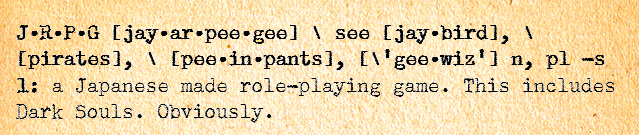
An unavoidable problem with this JRPG meaning is about ethnicity and geography. For example what if I’m Japanese but I made my RPG in Chicago? Or what if I’m part of a team that’s Mexican but we’re based in Tokyo? What if I’m straddling Japan and the Pacific Ocean, etc.
It gets silly fast. It gets sillier if I begin to get all existential about why does ethnicity even matter. Or how does time transform someone into a citizen? What’s the meaning of life anyway?
 But this JRPG meaning can work well by itself because Japan as a country is a very special case study. It has probably the oldest lineage of civilization of any nation on earth, and it’s widely stated how 98.5% of its populace is of Japanese ethnicity. That’s pretty unique.
Put just, Japan is a fun country to place under the magnifying glass. That’s why my ears perk up when I hear ‘JRPG’. I’m excited to see what comes out of there next.
The significance of the ‘J’ in JRPG is that it identifies a genre for those who find Japan’s cultural exports fascinating. And who also like RPGs.
When an RPG Maker Game is considered more Japanese than Actual Japanese Games, Something is Wrong.
But many gamers just want a piece of a certain trend in Japanese RPGs. If you were introduced to JRPGs with Chrono Trigger and Final Fantasy VI, maybe that’s all you want to see going forward.
For example, many Western indie game designers love old school Final Fantasy so much that we see that template recreated over and over again.

Is this what’s considered authentic Japanese nowadays:?
And that’s wonderful. But it doesn’t make any game out of RPG Maker ‘Japanese’ merely because it has random encounters and anime portraits.
The JRPG definition that acknowledges Japanese developers and their output as Japanese in origin just works better in 99% of cases.
A Better Understanding of the ‘JRPG’ Meaning
In this analysis of the meaning of JRPG as a term, my main goal is to come to peaceful understanding.
I just want to say in a comment section, ``Hey fellow gamers, some of my favorite JRPGs are Final Fantasy VII, Bloodborne, and Vagrant Story´ and not get railroaded because `your selection is invalid because x, y, and z don have big enough eyes on the characters.´´
I’m kidding. But I hope you see the point.
In the end I like the simple definition that conveys the most information. JRPG means a Japanese made role-playing game. Boom. Done. I like that.
Maybe the term won’t last. Maybe Japan will become a globalized melting pot of game developers in the future. But I’ll gladly face those realities if they come.
It certainly beats the endless sets of rules, rubrics, and infinite personal criteria between every person out there who seems to know what “Japanese” really means in a JRPG.
All images are screenshots and promotional materials from their respective games. Dark Souls, Code Vein — FromSoftware / Bandai Namco. Jade Empire — BioWare / EA. RPG Maker — Kadokawa. All trademarks belong to their respective owners. Originally published April 1, 2020. Last updated: March 24, 2026.
To learn more about the games that define this genre, you can check out the ranking of battle systems for an analysis of the combat design, and the 2026 recommendations page for picks for newcomers. For what's next, check the upcoming releases page, and if you want options under 20 hours, the shorter RPGs guide is best. The horror JRPGs list explores the darker side of the genre.
Frequently Asked Questions
What does JRPG stand for?
JRPG stands for Japanese Role-Playing Game. At its simplest, it means a role-playing game made in Japan. However, the term has become contentious — some argue it describes a set of design characteristics (turn-based combat, party systems, linear stories) rather than geographic origin.
Is Dark Souls a JRPG?
Yes — Dark Souls is made by FromSoftware, a Japanese developer, making it a Japanese RPG by definition. The confusion arises because Dark Souls does not fit the stereotypical JRPG design template of turn-based combat and anime aesthetics, but geographic origin is the most consistent definition.
What is the difference between a JRPG and a WRPG?
JRPG refers to RPGs made in Japan; WRPG (Western RPG) refers to RPGs made in Western countries. In practice, people often use the terms to describe design philosophies — JRPGs are associated with linear stories and turn-based combat, WRPGs with open worlds and player choice — but these are stereotypes, not rules.
Is Elden Ring a JRPG?
By geographic definition, yes — Elden Ring was made by FromSoftware, a Japanese developer, in collaboration with George R.R. Martin. The game is a Japanese-made RPG. However, many gamers resist calling it a JRPG because its open-world design and Western fantasy aesthetic don’t match the stereotypical JRPG template — which is the same debate that surrounds Dark Souls.
What was the first JRPG ever made?
The first JRPGs predate Dragon Quest and Final Fantasy. Japanese developers were making computer RPGs in the early 1980s, influenced by Western titles like Wizardry and Ultima. One of the earliest known examples is the 1983 title Danchi-zuma no Yuwaku, a stat-based RPG on Japanese home computers.
Are all Japanese RPGs considered JRPGs?
If you use the geographic definition (JRPG = RPG made in Japan), then yes. However, many gamers use a narrower definition based on design characteristics like turn-based combat, linear stories, and anime art styles. This narrower definition excludes games like Dark Souls and Elden Ring, which are made in Japan but don’t match the stereotypical JRPG template.